A debrief from Higher Ground’s California Primary AI Debrief, June 24, 2026
The 2026 midterms are shaping up to be the first true AI election in American politics, and California’s primary was the first major stress test. With a crowded gubernatorial field, a nationally watched LA mayoral race, and contests up and down the ballot, the Golden State gave us an early look at how AI is reshaping campaigns and voting itself.
On June 24, the Higher Ground Institute convened investors, funders, and senior practitioners for a closed-door debrief with the people who just ran the experiment: technologists monitoring what chatbots tell voters, strategists who worked the top races, and campaign builders who shipped their own AI-powered tools in the field. This post shares the early learnings. It is less a set of predictions than a pulse check from the front lines. Here’s what we discussed:
Voters are asking AI who to vote for
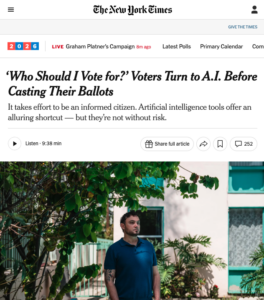
The New York Times reported last week on what may be the most consequential shift of the cycle: voters are using AI chatbots to research and fill out their ballots in meaningful numbers for the first time. One Corona, Calif. voter, overwhelmed by 61 candidates for governor, uploaded his ballot to Claude and described the result as the most informed voting he had ever done. A Baltimore voter said his ballot research dropped from roughly 20 hours to one.
Our debrief data backs this up: Fresh polling shared at the event found that 62 percent of voters will use Google search, where AI Overviews now sit on top of results, and 15 percent explicitly plan to use an AI chatbot to learn about candidates. Fifteen percent is a small slice of the electorate, but it is a decisive slice in close races. And the trust picture is complicated: about a third of voters trust candidate-generated information more than AI-generated information, and another third trust neither.
What are the chatbots actually saying? Practitioners who systematically monitored chatbot responses across the California ballot surfaced findings every campaign should note:
- Chatbots got the basics right. Across hundreds of collected responses on the governor’s race, the leading models did a good job listing the full field, no small feat on a crowded California ballot.
- Web grounding is everything. When models searched the web, their answers tracked the actual state of the race and picked up breaking news within hours. When they leaned on training data, they got stuck in the past. Some responses discussed a prominent candidate’s 2020 presidential run without knowing he was running for governor in 2026.
- The citation map is not what you’d expect. Local nonprofit newsrooms carried enormous authority with the models. Facebook was a top-cited domain, including public posts and comments. The Secretary of State’s candidate statement page was cited constantly, yet only one of the four tracked gubernatorial candidates had actually submitted a statement there. Ballotpedia profiles, often overlooked by campaigns, are read closely by LLMs.
- Answer engine optimization is not SEO. The sources LLMs rely on are ranked differently than organic search results, and long-form substantive content performs well with models even when it would never hold a human’s attention. Ranking on Google does not mean showing up well in an AI answer. You may see discussions around this refer to GEO (generative engine optimization).
The takeaway: an “AI answer” about your candidate is now part of your earned media surface whether you manage it or not. Campaigns that fill authoritative sources (candidate statements, Ballotpedia, local news, .gov pages) with accurate, substantive content are shaping what millions of voters will be told this fall.
Want to learn more about GEO? Check out Caucus.ai and Run for Something’s Campsite.
I will add a personal note. As a California voter, I used Claude to research candidates on my ballot. You can see my chat transcript here. I loved it- it felt like talking through the ballot with one of my most politically savvy friends. It emphasized that the decisions were mine, offered context and strategy, and made it far easier to complete the full ballot, not just the top of the ticket. The voter experience upside here is real. So are the stakes for accuracy, which is why the monitoring and optimization work presented at our debrief matters so much.
Behind the scenes, AI is everywhere in campaign operations

The public face of AI in this primary was generated content, most visibly in the LA mayor’s race. But the deeper story from our debrief, echoed in the Times’ recent front page article covering Higher Ground Institute’s work to support campaign AI adoption, is that the usage is largely operational. A survey cited by the Times found 87 percent of campaigners and strategists now use AI daily. Canvass programs are running voter conversations through AI synthesis to sharpen persuasion targeting. Opposition research shops are using AI to sift campaign finance data at a scale no human team could match.
Our debrief speakers described the same pattern on the ground in California: AI for content development and repurposing, fundraising copy, creative, ideation, and increasingly for data analysis, taking large amounts of unstructured information and turning it into decisions.
For candidates who are more sensitive to potential tension around using AI on campaigns, back-of-office operations is a way to help use technology during campaigns efficiently without opening themselves up to ire.
The adoption gap is a double whammy for the left
Data shared at our debrief from the American Association of Political Consultant’s bipartisan AI & Emerging Tech committee puts the GOP roughly 20 percentage points ahead of the left on AI adoption, a lead that has held even as adoption grows on both sides.
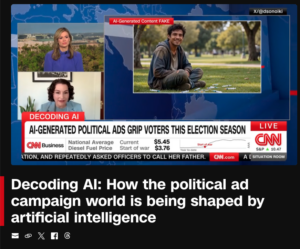
That gap compounds in two directions. Operationally, AI-adopted campaigns (so, more campaigns on the right than the left) are benefiting by simply being able to do more: more content, more analysis, more experimentation per dollar and per staffer. And externally, as I mentioned on CNN last month, GOP campaigns are generally more comfortable deploying AI in public-facing, provocative ways while the public’s taste for AI content is still being formed, and they are doing it with fewer ethical constraints.
Now, the left’s hesitancy is not irrational. It is rooted in valid questions about values alignment, labor, authenticity, and the role of big tech in democracy. Campaign staffers are overworked, underpaid, and understandably anxious about what AI means for their jobs. We learned this firsthand when bringing Quiller to market in 2023. But last month’s debrief presenters were blunt: while we spend our energy getting comfortable with AI’s existence, our counterparts are spending theirs figuring out how to win with it. We are at a fork in the road. We can step back while they engage, which is how we lost the content and podcast battle last cycle, or we can engage in ways that are authentic to our style of campaigning: organizing, relationships, and trust.
The bright spots: bespoke tools and infrastructure are getting a big boost
The most inspiring part of the debrief was the third act: four concrete demonstrations of what AI-assisted engagement looks like. There were also a few trends we see starting to emerge that are particularly exciting:
First, existing infrastructure is layering in AI capabilities that make proven tactics dramatically more powerful. One relational organizing platform used in the gubernatorial primary showed how AI now optimizes supporter-shared content for each social platform automatically, and, most strikingly, translates it on the fly. A campaign toolkit drafted in English becomes a personal message in Spanish or Hindi, shared on WhatsApp with one friend. In a state as linguistically diverse as California, that single feature turns relational organizing into something closer to its full promise.
Second, campaigns are building their own bespoke tools, and it is working. One gubernatorial campaign stood up an AI director role and a volunteer tech team that built its own gamified canvassing app in weeks, reaching over 14,000 doors with 200-plus users. A congressional campaign’s two-person engineering team built a vertically integrated platform covering canvassing, phone banking, events, and analytics, knocking over 500,000 doors, placing 1.5 million calls at roughly a quarter of the usual per-call cost, and connecting their database to Claude so any staffer could ask plain-language questions of live field data. These are things that were simply not possible for campaigns at this budget level two years ago.
The lesson is not that every campaign should vibe-code its own stack. It is that the build-versus-buy question is now genuinely open, and the ecosystem needs guidance on when an established tool is right and when a bespoke build makes sense. That is exactly the kind of coaching Higher Ground Institute is building into its practitioner programs.
Third, practitioners can now vibe co-create entirely new engagement models, not just tools. One organization demonstrated a vibe-coded membership-style platform, where supporters apply, join, and become part of a community of like-minded people rather than names on a contact list. Members interact with a customized AI to talk through issues and look up their voting information, and they receive personalized updates on news and local events, published through agents tuned to the values of the community itself. It is a fundamentally different engagement modality. Instead of one-way messaging and an endless stream of asks, people get an experience that is personalized, participatory, and built for a sharing-first media landscape. Whether any particular platform endures, the underlying model shift matters: the cost of experimenting with new organizing structures has collapsed, and the next great engagement model may come from a weekend build rather than a traditional roadmap.
Higher Ground Labs is encouraging innovation and adoption
This is also where our investment work comes in. Higher Ground Labs’ Agentic AI Open Call drew more than 50 applications from startups building next-generation, agentic tools for campaigns. We are now deep in technical diligence with our finalists. Our strategy is to get these tools into the field in 2026, learn as much as possible from real races, and scale those learnings and solutions into 2028.
On the Institute side, the community is growing fast: monthly AI Open Mics drawing hundreds of practitioners, Claude Code study halls, an expanding resource library, and a database of nearly 100 AI tools for campaign work. If you are a practitioner, funder, or builder, there is an onramp for you.
The campaigns we’ve always dreamed of
Here is my perspective after going through this primary and debrief both as a voter and as a practitioner: AI finally makes it possible to run the kinds of campaigns organizers have imagined for decades: deeply relational, responsive to what voters are actually saying, multilingual by default, and analytically sophisticated all the way down the ballot.
But none of it is automatic. It requires adoption, and adoption requires trust, training, and tools built for our values. It requires smart policy, including meaningful disclosure standards for AI in political communication. It requires cooperation from the frontier labs on pro-democracy initiatives, because their models are now a primary information source for voters. And it requires us to keep working through the genuinely hard questions about authenticity, labor, and power even as we move.
The general election is the next test, and it is coming fast. If the California primary taught us anything, it is that the practitioners willing to experiment, share what they learn, and build in the open are creating advantages the whole ecosystem can inherit. Our job is to make sure they have the capital, community, and knowledge to do it.
Explore the HGI AI Resource Guide, register for the next AI Open Mic, and learn more about the Agentic AI Open Call.
And be sure to follow our amazing presenters:
-
- Meg Schwenzfeier: Caucus.ai
- Jordan Haines: Run for Something
- Mike Nellis: Becerra Consultant, Quiller co- founder, & AI + Campaigns Expert
- Tudor Mihailescu: Becerra & Steyer: Social Amplification, Sosha founder
- Forrest Liu: Director, Garry’s List
- Samuel Finegold: Matt Mahan for Governor AI Director
- Nick Gebo & Nisala Kalupahana: Tech Team, Saikat for Congress