Written by: Kate Gage, Executive Director of Higher Ground Institute
What happened when we stopped asking “what worked in 2024?” and started asking “what do we need to win in 2032?”
The progressive political community has developed a strong muscle for looking backward. After every election cycle, we do the autopsies and debriefs. We examine what worked, what didn’t, and what we’d do differently. At Higher Ground Institute, we think that’s genuinely important—it’s why we co-host the Election Tech Debrief every two years, author the Political Tech Landscape Report built on research from every major cycle, and conduct dozens of private discussions reflecting on successes and learnings to carry forward.
There’s also been a lot of discourse about how the traditional campaign playbook is broken. How Democrats perfected strategies and tactics that are outdated and have not adapted to our attention economy.
Which is why what this moment requires is looking forward. A lot more forward.
Not just “what’s our 2026 strategy” forward. But genuinely, imaginatively, uncomfortably forward. What does a campaign look like in a world where synthetic media is ubiquitous? How do we organize when the information environment is fractured beyond recognition? What does voter contact even mean when the algorithm determines what people see more than any door-knock or TV ad? We rarely create the space to ask those questions together.
That’s why we ran a simulation.

Campaign Website for one of the Candidate Teams
What We Did
Late last year, the Higher Ground Institute convened a highly curated group of people—campaign consultants, digital strategists, tech founders, Hollywood showrunners, YouTube creators, and organizers—for a 48-hour immersive simulation exercise set in a fictional 51st state in 2028. Five competing campaign teams fought for a Senate seat under a simple constraint: the playbook you used last cycle doesn’t exist. Figure it out in real time.
In roughly 28 hours, the teams generated 45+ distinct tactics and 35+ campaign artifacts—memos, videos, data dashboards, apps—using about 15 different AI tools and creative platforms. One participant noted that the group surfaced more new ideas in a few hours than many of us had seen produced in years of traditional convenings, trainings, and retreats.
Why Simulation Works as a Learning Format
The format does something hard to replicate: it suspends the usual constraints. In their day jobs, most campaign managers can’t propose stopping all TV ad spend, suggest replacing phone banking with coordinated algorithm-gaming, or float converting campaign HQs into mutual aid centers. The risk is too high, the culture too conservative, the incentive structure too misaligned. In the simulation, they could. And they did.

Sample Campaign Material developed by one of the teams
Think of it like the hackathon model—you’re not building the finished product, you’re rapidly prototyping, testing assumptions, and identifying what’s worth investing in more seriously. The value is in the process as much as the output.
It also turned out to be the most effective method for AI adoption we’ve tried to date. People who had never used a generative AI tool were building videos and multi-channel campaign workflows within minutes. Not because someone explained it to them, but because they needed to keep up with their team and their “opponents.” One participant described being “radicalized” about the power of these tools after a career of skepticism.
What We Actually Learned
Industry cross-pollination isn’t just a nice-to-have. It’s what changes approaches and minds. The highest-rated part of the convening was the curation of the room. By mixing traditional political operatives with people from entertainment, media, foresight planning, tech, and the creator economy, we created conditions most campaign convenings don’t. Many participants assumed they’d know everyone there. They knew only a few people. That friction was generative. The most valuable insights consistently came from people operating outside their usual lane.
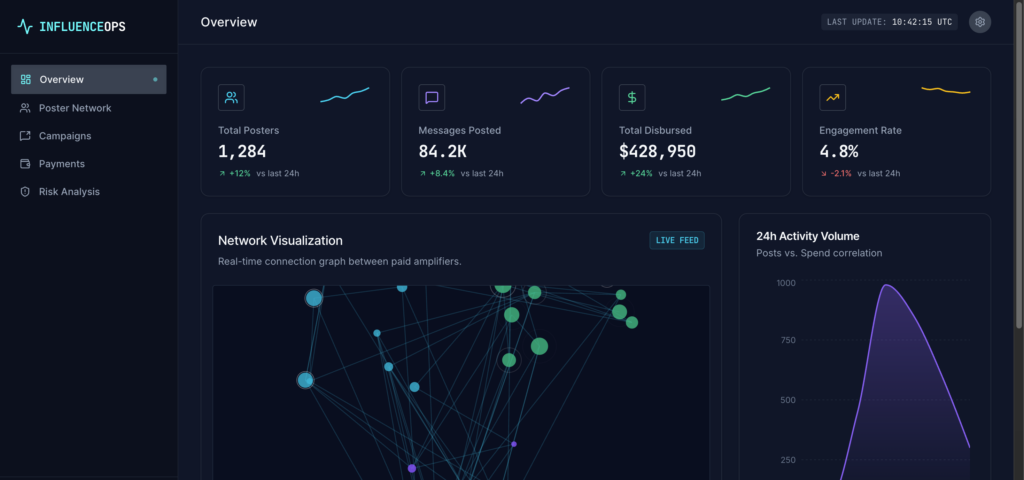
Sample social media tracking dashboard built by one of the campaign teams
Innovation spreads through individuals, not institutions. Legacy institutions aren’t well-positioned to lead on rapid experimentation—that’s not a criticism, it’s structural. What does work is finding and supporting the individual campaign managers and organizers already willing to try new things, and building peer networks that let them learn from each other, take risks, and share what they find. The open question—and one we’re actively working on—is how we make sure these newly creative individuals have the structures and resources to actualize their ideas.
There is no shortage of creativity—only a shortage of spaces safe enough to use it. The simulation produced “more new ideas in two hours than the industry often produces in a decade,” as one organizer put it. The ideas were in the room all along. We just hadn’t created conditions where people felt free enough to say them out loud.
The future of campaigns is less broadcast, more decentralized. Almost universally, teams moved toward earned media, creator partnerships, and relational organizing—and away from traditional advertising models. This wasn’t a theoretical preference; it emerged naturally from teams trying to figure out how to actually win in a more fractured, high-trust-deficit environment. The TV-ad-centric playbook is losing efficacy, and the replacement isn’t just digital ads. It’s culture.

Campaign “memo” distributed after the second round of voting to summarize the state of play
What This Could Look Like: Prototype Programs for 2026
The simulation surfaced not just ideas, but concrete program models worth piloting this cycle. Three emerged directly from participant feedback and team design work:
- Campaign Innovation Lead (Chief AI/Innovation Officer). Campaigns designate or hire a dedicated Innovation Lead—cross-team visibility, embedded but not subordinate to any single department—who owns a prioritized backlog of operational pain points and is accountable for shipping solutions into live workflows. In practice: automating list cutting and volunteer follow-up, streamlining onboarding and FAQ triage, building content pipelines, and standing up lightweight narrative monitoring. More organizer time coaching volunteers. Less staff burnout.
- Internal Campaign Hackathons. Short, focused sprints—one or two days, scheduled at key moments in the campaign calendar, led by the Innovation Lead—with clear problem statements defined in advance and small cross-functional teams from field, digital, comms, and data. The requirement: at least one prototype ships into live operations immediately. Focus areas: volunteer onboarding and retention, relational organizing ladders, narrative monitoring and rapid response.
- Campaign Manager Innovation Cohort. A curated Signal group of risk-tolerant campaign managers who’ve already demonstrated appetite for experimentation, with a kickoff session to build trust and a former CM on retainer to lightly facilitate—someone who understands the pressures of the job and can help translate ideas into real-cycle application. No curriculum. The value is peer learning, shared risk, and a feedback loop where what works gets shared and what fails gets documented. We’re already building this. If you’re a campaign manager who fits—reach out.
What We’d Do Differently Next Time
Shorten the simulation, deepen the debrief. The simulation ran across both days, and by the time teams presented their final strategies, energy had dipped. We’d restructure to complete the simulation in one day and use the next for structured cross-team conversation, small-group discussion of real-world barriers, and time to connect outside your team. This also means they could be run in a single day, or tagged onto the end of an existing conference.
Make the scenario harder. Several participants pushed us to go further—to incorporate election subversion, contested certifications, and structural democratic threats, not just ground game and messaging tactics. Campaigns shouldn’t just be optimizing turnout mechanics in isolation. They should be gaming out contingency scenarios together, including break-glass emergency plans for when the process itself is under threat. That’s shaping where our next scenario goes.
Broaden the tool set beyond generative AI. The simulation naturally gravitated toward content generation and consumer-facing tools. Participants wanted more exposure to enterprise applications—AI for organizing, relational tools, operational efficiency. We’re building that into the next design.
Who Should Be Running These
The honest answer is: all of us. State parties who want to shake their staff out of the last-cycle mindset. Campaign leadership teams who want to stress-test assumptions before they’re in the field. Soft-side organizations trying to figure out how to adapt their model for a more complicated environment. Training programs looking to complement existing curriculum with something more experiential.
The infrastructure doesn’t have to be elaborate. The key ingredients are a credible future scenario, a competitive team structure, facilitation that moves things forward, and—critically—the right mix of people in the room. The magic comes when a YouTube creator, a showrunner, and a field organizer are trying to solve the same problem together under time pressure.
What we’re working on now is making this replicable: a toolkit that state parties, campaigns, and organizing groups can run independently, with templated yet customizable scenario materials, facilitator guides, and tool stacks.
The Bigger Point
We are in a moment that rewards adaptation and punishes the status quo. The information environment is not only decentralized, it is changing faster than most campaigns can track. The organizing models that worked a decade ago are showing real strain. The tools available to campaigns—and to our opponents—are evolving in ways that are hard to fully anticipate.
We need spaces that force us to practice thinking about the future together. Not just talk about it, not just read about it, but actually inhabit that future long enough for our instincts to start updating—immersed in scenarios and possible futures until our old reflexes give way to new ones.
The Simulation was a first draft. We learned a lot. But the model works, and the community is hungry for more of it.
If you’re interested in bringing this innovation model to your organization, state party, or team—reach out to institute@highergroundlabs.com. We’d love to talk.
The Higher Ground Institute’s Tactical Directory and AI Tool Sheet from the Simulation are available to the community. Future simulations, salon series, Open Mics and a Campaign Manager innovation cohort are in development for 2026. View HGI’s AI Resource Guide for the latest AI resources.